Farewell, Galapagos

IMG_0474We’ve wrapped up our time in the Galapagos and headed onward from that magical place.  I was going to just briefly talk about our last couple of relaxing days, but then I reread Bob’s last entry where he was supposed to talk about our volcano hike but instead seemed to spend an inordinate amount of time discussing $7 dinners instead.  (Not that I also didn’t appreciate the $7 dinners.)
Our hike was a guided tour of the Sierra Negra volcano (the largest on this island at 1200 meters) and the nearby, much smaller Volcan Chico.  It was a fascinating glimpse into the dramatic variations in ecosystems here.  As we hiked up to the Sierra Negra crater, everything was shrouded in mist.  We were surrounded by greenery — mostly guabana and guava trees.  Eventually we could see that the land seemed to just end on our left, and thus assumed we had reached the crater — but we could see nothing but white.

IMG_0499After reaching the top, we started down the other side — and immediately, we were in another world.  The mist vanished, the sun shone down, and stretching for miles ahead of us in all directions were fields of lava rocks, interspersed with fumaroles, lava tubes, craters where lava tubes had collapsed, and the occasional cactus.  We were able to see lava that had existed for 15,000 years, alongside lava from the last major eruption in 1979.  It was an otherworldly landscape.

Crater of Sierra Negra

Crater of Sierra Negra

When we made the return trek, we had another surprise waiting for us — the mist on the mountaintop had cleared, and we were able to see across the Sierra Negra crater — the second largest in the world.  I think our guide said it was 10 km in diameter.  The steeply sloping sides were covered with greenery, and the bottom was black lava rock.  It almost looked like cliffs dropping into the sea.  By the time we got back down to the beginning of the trail, we were back in the mist.

This trip entailed almost 10 miles of walking, but it wasn’t too steep and the kids handled it fine.   Unfortunately, disappointment awaited back in town.  Every day we’ve been passing a place that sells milkshakes, and it’s had a sign saying it was closed until Monday.  We took this to mean that it would be open the day of our hike, and that we could reward ourselves with milkshakes afterwards.  Alas, apparently they meant closed through Monday.   As a consolation prize I allowed them to get double-scoop ice cream cones.  (We’ve been getting ice cream pretty much every day and calling it “lunch”, but usually I hold firm to the single scoop.  We went back Tuesday for milk shakes and they were delicious.)

Priscilla and Sandra at La Jungla Hostal -- highly recommended!

Priscilla and Sandra at La Jungla Hostal — highly recommended!

Tuesday was our last full day on Isabela.  We rented snorkels and headed down to a little cove by the dock where you can enjoy world-class snorkeling right from shore.  At first we didn’t see too much other than some colorful fish, but eventually we were rewarded by the arrival of a sea lion.  If anyone out there maintains a bucket list, I would suggest adding “snorkel with sea lions” to it.  Unlike the other sea creatures, the sea lions here are friendly and playful.  They literally swim circles around you, flipping and diving, clearly mocking you for your inferior swimming skills.  Sometimes one will dart right at you, coming within inches of your mask before jerking back and veering off to the side.  You can almost here them shouting “boo!” and snickering as you fall back in alarm.  This one swam with us for 10 or 15 minutes of sheer delight.

IMG_0520In the evening we enjoyed our last $7 dinner, accompanied by two other guests at our hotel — Jeremy from New Zealand and Isabel from Germany.  We’ve discovered that one of the $7 restaurants seems to be a cut above the others, and greatly enjoyed our dinner of cream of carrot soup, fish/shrimp/chicken with rice, passion fruit juice, and some kind of delicious cake.

Our boat back to Santa Cruz wasn’t until 3pm on Wednesday, and Sandra kindly let us stay in our room until then — so we rented body boards for the kids and enjoyed a final morning on our beautiful beach.  We had plenty of time to make our way to the dock, and this time our boat actually left on time!  On the other hand, it was 2 people over the posted capacity, so conditions were rather cramped.  (The way they handle boat passengers here is very amusing to me.  Clearly they don’t want any clueless tourists ending up in the wrong place, so when you check in they give you a large laminated placard with the name of your boat that you wear around your neck.  So essentially we’re labeled like pieces of luggage.  I like the system, though, as it gives a bit of confidence that if you’re going the wrong way someone will notice.)

Labeled for the "Gabi"

Labeled for the “Gabi”

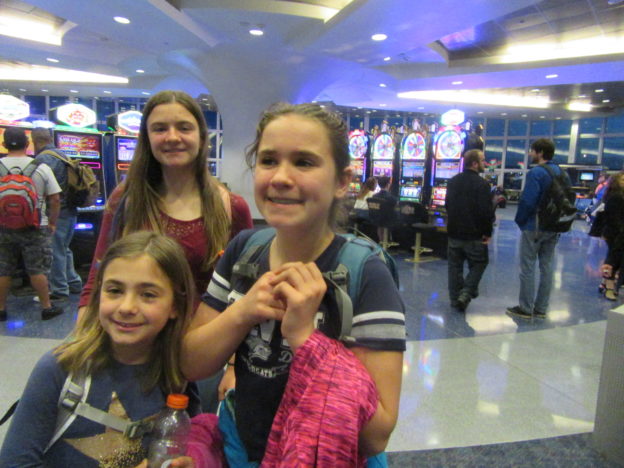
After a pleasant dinner and an uneventful night back in Puerto Ayora, we headed back to the airport this morning to embark on the last leg of our trip — 5 days in Quito, Ecuador.  Our delayed-travel curse definitely seems to be broken, as we were taxing down the runway 15 minutes before our flight was even scheduled to depart.  The first leg, to Guayaquil, was amazingly smooth.

The hop from Guayaquil to Quito was another matter.  The former is at sea level, and the latter at 3000 meters elevation, in the middle of the Andes.  As we approached Quito, it wasn’t so much that the plane descended as that the

Snow-capped mountain as seen from the airport parking lot

Snow-capped mountain as seen from the airport parking lot

land rose up to meet us.  And suddenly the plane was rocking with turbulence in heavy winds.  Finally, as we struggled with nausea, we approached the runway — only to have the plane pull back up at that last minute.  At this point some of the more dramatic passengers on the plane began to wail and pray.  Fortunately, on the second pass the wind apparently died down and we landed uneventfully.

On our ramblings tonight we found a parking lot full of food trucks.  We enjoyed some fresh-made Homer Simpson mini-doughnuts.

On our ramblings tonight we found a parking lot full of food trucks. We enjoyed some fresh-made Homer Simpson mini-doughnuts.

Now we’re ensconced in an absolutely amazing 3-bedroom apartment I rented on airbnb.  We’re on the 10th floor with floor-to-ceiling glass windows overlooking the park and the city beyond.  From the rooftop deck, we can see almost the whole city, which is in the shape of a bowl inside the mountains.  Our host, who picked us up at the airport, was incredibly helpful. So far, we aren’t suffering too much from the altitude. We can’t wait to explore tomorrow.


This is what $90/night gets you in Quito.

This is what $90/night gets you in Quito.

A geological and economic history of Galapagos

The first people who came to the Galapgos Islands had one concern.

Peeking into the crater of El Chico Volcano

Peeking into the crater of El Chico Volcano

Scratch that. The first people who came to Galapagos were probably Incas who looked around and said, we’ve already got volcanoes at home what do we need this place for? At least, that’s how our tour guide Xavier explained it yesterday as we hiked north from the Sierra Negra Volcano crater across the path of two major lava flows (the more recent from 1979) to a side-spout called El Chico Volcano.

There certainly are plenty of volcanoes here: five major ones on Isabela Island alone. The one we toured yesterday has at least 100 “lava chimneys” or holes of various sizes that reach way down to where all the action is at. Sierra Negra last erupted in 2005, though not nearly as spectacularly as in ’79 when thousands of acres were covered with lava over a span of three months.

The Incas likely went home pretty quickly.

What I meant to say was the next wave of people who came here — fishermen and whalers in the 1500s or so — had one concern. Well, from my experience I can say they probably had several concerns, like: I hope my kids don’t fall into that volcano; and How can I keep sand from destroying our sole remaining camera? But they had one main concern, and this is supported by our guide, Xavier: How were they going to make money off this place?

Sitting on a lava wall

Sitting on a lava wall

It was not an easy question to answer. The place is beautiful and it looks like it should be a money pot, but mining salt and sulfur didn’t really cut it. It was too far offshore to be a real productive exporter of fish (though fish did factor into the eventual answer, as you’ll see).

It was still very sleepy here when Darwin toured it in the mid 1800s. In fact this Island — the largest in the archepelago — had only a couple hundred residents as the last millennium mark approached. Now, though, Xavier says the population was more than 2,000 ten years ago when the last census was taken, and he estimates that there are more than 5,000 people living here now.

Of course tourism is the main engine for growth here, and all of the tours we’ve been on have been fabulous. Each one is different from the one before. Each guide is extremely knowledgeable and personable.

IMG_0516

We make it a point to stroll by early in the afternoon to check out our dinner options.

But I have come to consider the tours, and all of the daytime stuff here — the beaches and animals and such — to just be time-killers for the real main even on Isabela: $7 dinner.

That’s right, each night we cruise Calle Antonio Gil’s restaurant row and peruse the placards offering the day’s set menu items. At least five restaurants do this, all offering slightly different stuff but all basically the same three-course menu (and juice!) for seven bucks. Except one that sets its price at $6.50.

I ask you: Can you beat that?

Granted, it’s not a big dinner, but it’s big enough. We don’t have the facilities to deal with leftovers, anyway. There’s generally enough variation on the small menu of the day to keep everyone happy. I get fish; several other people get shrimp (at one place the shrimp option costs a little extra), Nadia and maybe someone else gets chicken or meat. There are various sauces. We get bowl of soup before the entree, a nice glass of juice, several side dishes, and a postre (Spanish for dessert).

Check out the Coke bottles. What were we thinking?

Fish with celery sauce

We did run into trouble one night when no place had a viable non-fish option. And one night two girls decided to split one of the fixed price entrees and a pasta dish off the regular menu. Regular menu options not only tend to be more expensive, they also include neither juice nor postre. Once everybody but me shared a $25 pizza, but I was the only one who got juice and dessert (it was Jello).  Get this, way back on the first night before we really figured things out, everyone ordered drinks on top of our set price menu. We must’ve looked like a bunch of tourists!

While every night the dinner bill has been $50 or below with tip, it wasn’t until last night that we finally hit the sweet spot with a $35 bill. Tonight I plan to shake things up a little by requesting menestra, or beans, instead of the french fries — at no extra cost, mind you.

How do you make money off me in the Galapagos?   $7 at a time.

Still cruising

The demise of our underwater camera came one and a half snorkel trips too soon, by my estimation, but we may have lucked out.

By “us” I mean you, too, because you may get to see some of the cool pictures our guide Carlos took of our dive at Los Tuneles yesterday.

Then again, you may not, because he copied his pictures to our memory card, but we can’t figure out how to access them. With luck, we’ll be able to get to the shots of a school of golden rays and the closeup of the seahorse once we’ll get home. If not you’ll just have to take our word that we saw those things.

IMG_0417

If you look close, you might see a sea turtle gliding by in the shallow channel.

Until then, we do have some pictures from the terrestrial part of our trip, which brought us up the coast from Puerto Villarmil to a place where lava and the sea once met in interesting ways. The result is a maze of calm, clear water running around and through fingers of black lava rock, archways and caves.

IMG_0435

Carlos showing … there’s no way I can write it so it won’t sound dirty.

IMG_0442

Sibling rivalry, vicious among boobies

In the first five minutes after landing, we saw three sea turtles swim by. Then we walked a bit to find a few Blue-Footed Booby nesting sites. Some had eggs; some had chicks; some had one of each. We learned that nesting couples incubate two eggs, but usually only manage to gather enough food for one of the fledglings to survive. Interesting birds, these boobies.
The tour allowed us to encounter several new animals that we hadn’t seen yet. The seahorse and rays are new to our list. We also saw Nasca Boobies, which are different from the blue-footed variety — for one, the larger chick pushes the smaller one out of the nest to spare its parents the problem of deciding which to feed; for another, it is the only booby endemic to the Galapagos. We also caught a shady glimpse of a manta ray while we were in transit. Carlos said they can grow up to seven meters wide. This one looked to be about two meters.

IMG_0449

I think we actually saw flamingos two days ago. Yesterday we discovered these birds which satisfyingly stood on one leg apiece.

The last new animal we saw today was the Galapogos flamingo, which we spied from the boardwalk cutting through an inland lagoon. The boardwalk brought us to another tortoise breeding center (the tortoises here do well in the wild once they’re grown up a bit, but they have trouble getting born in the wild for various reasons, including wild pigs eating eggs and invasive guava trees making it hard for parents to dig nests). At the breeding center were many smaller versions of the tortoises we saw on on bike ride through the Humedales the day before.

Watching over the little ones

Watching over the little ones

They’re cute — and decidedly more active, apparently — when they’re this age.

Freewheeling

Laguna

Laguna

We’re loving life here on Isabela.

Flamingo - mission accomplished!

Flamingo – mission accomplished!

Though we rented our room through airbnb, it’s part of the La Jungla lodge — and we’re enjoying the benefits of having the friendly, helpful, and kind Sandra assisting us with all our planning. We told her the tours we wanted to do, and she researched tide tables etc. and set everything up optimally. We even get picked up right here at the lodge for all our tours — Sandra just collects our money and tells us what time to come downstairs.

Though we only have a one room for the five
of us, our “living room” is the downstairs, open air spaces here — complete with hammocks, tables, and chairs. Our yard is the beach, which we generally have all to ourselves. The kids love starting the day with a big breakfast IMG_0339here, which includes juice, coffee, steamed milk, and hot chocolate powder served in a big bowl. (Lunch is snacks bought at the store and ice cream. Dinner is a fixed-price meal at one of the several seemingly interchangeable side-by-side Ecuadorean restaurants, where we get soup, a choice of entree (some kind of grilled meat/fish/shrimp which always comes with rice and french fries), juice, and a small dessert for $7. We’ve been so pleased with this system that we haven’t even bothered to ask Sandra about using the downstairs kitchen.)

IMG_0350Yesterday we didn’t have a formal tour arranged, so after a morning swim we rented bikes and set off to explore Los Humedales (the Wetlands). Following the beach road that runs right by our hotel, we wound our way along gorgeous coastline on one side and a series of lagoons on the other, weaving in and out of mangrove forests . The trail (really a road, but without vehicular traffic) was impressively maintained, with clear signs pointing out the frequent pull-offs to see lagoon or coastal views, tiny private beaches, or impressive rock formations. Eventually we left IMG_0371the coastline and headed into the hills, sometimes riding through tunnels formed by the tree branches arching over our heads. We saw several wild giant tortoises in or near the road. It was magical — and we had it almost all to ourselves.

The end of the ride got pretty tough. It was pretty steeply uphill, and as luck would have it this was the hottest, sunniest day we’ve had yet. We’d misplaced one of our two water

Stairs to the lookout point

Stairs to the lookout point

bottles early on so everyone was quickly parched. And our reward was more climbing — on foot. We eventually came to a long staircase going up a steep hillside, leading to a platform with breathtaking views to the ocean and across Isabela. (Luckily I had a small package of gummy bears with me. I’d been saving it to help combat nausea on the boat ride back from Isabela, but Zoe had the brilliant idea of using it to motivate her sisters up the hills.)

IMG_0360

IMG_0368The end of the trail, a bit further along the uphill road, was the Wall of Tears. This is a huge stone wall that was build in the 40s and 50s, when there was a penal colony here. The prisoners were made to build a pointless wall in the middle of nowhere just as punishment. Many of them died. Nonetheless, the wall was an impressive sight.

Riding back into town downhill was lots of fun — luckily, since by this time we were all completely parched. We’d hoped to locate our water bottle on the way back, but no luck — so we had to make it to our hotel, where we gulped liters of water before heading into town to return the bikes. A refreshing swim in the ocean to cool off topped off our afternoon.

Wall of Tears from the top

Wall of Tears from the top

Sharks, beaches, & ice cream

IMG_8814P1020724Editor’s Note: our camera battery died in the middle of this tour, which was so frustrating since there were beautiful and fascinating things to see at every turn.  Thankfully, some kind fellow tourists, Chris and Christina, shared some of their photos with us.  With the state of wifi here, I’m sure emailing them was no small endeavor, and we really appreciate it.

When we went on the Tntorero Tour the water was really cold but the things we saw were very cool. It was a tour of the bay here in Puerto Villaril and they call it the Tintorero Tour because of all the sharks you see on it. (The word tintorero is a reference to color; the sharks in the bay have wite tips on their fins, or sometimes black tips  – Ed)

Snorkeling above the sharks

Snorkeling above the sharks

We saw sea lions, penguins, sting rays, eagle rays, and lots and lots of sharks. We swam through a narrow channel (a lava crack, according to the guide) and right below us in the channel were so many sharks. There were 50, probably, and most of them they were longer than my body. The channel was warm, but when we swam out I was very cold.

Tintoreras landscape

Tintoreras landscape

Then, on land we went on a hike to another channel full of sharks but we didn’t swim there. The island that we hiked on was totally made up of jagged lava rocks covered in white lichen. I thought it would be a good setting for a Star Wars movie. We saw baby sea lions playing and baby iguanas watching us from beside the path. Then we looped back to the boat and the boat took us past some rocks that had penguins on them. Then we saw some blue footed boobies and some more sea lions sitting on a platform in the middle of the bay.

Another shark tunnel, seen from above

Another shark tunnel, seen from above

I liked that we got to see lots of animals and that our tour guide was really nice. This tour was one of my favorites that we’ve done in Galapagos.

Before the tour we spent the morning and part of the afternoon at the beach right outside our hotel. There are lots of waves. It was really fun because Zoe and I tried to jump and dive over and under them. We also buried ourselves in the sand. This beach was fun because of the waves and the really, really soft sand. We didn’t even want to leave when it was time for the tour.IMG_0311

We didn’t even want to leave for ice cream for lunch. Nadia and I got chocolate ice cream bars and Zoe got mango. Mom got coconut. P1020720

IMG_8848

Bigger (and better?) things

Yesterday we packed up our cozy little house on the island of Santa Cruz.  The remainder of our time in the Galapagos (except for the last night, when we’ll be back on Santa Cruz for proximity to the airport) will be spent on Isabela, the largest of the islands in the Galapagos.  There are a couple of cool things I noticed about Isabela when looking at it on a map:  (1) It looks like a seahorse, and (2) the equator cuts through the northern end, right through the seahorse’s head.

IMG_0283We had to be at the dock by 1:30, so the first part of our day was spent packing, reading, and attempting to eat all the food we had left over.  (They are very worried about invasive pests here, and you’re not allowed to bring any kind of fresh foods into the Galapagos, or even from island to island.  Our bags were searched and tagged at the port.)

One challenge to our packing is that a substantial portion of our clothing is damp.  It’s not all that hot here — I would say most of the time the temperature is in the 70s — but it’s very humid and nothing ever dries.  The towels that we’ve been bringing on our beach and snorkeling trips have been in a perennial state of dampness ever since day 1, despite our dutifully hanging them up each day when we get home.  Bob even set up our little travel clothesline in the yard, but still no luck.  (The day before yesterday, when we went to the beach, there was a stone wall in the hot sun, and I spread out the towels as soon as we got there.  I carefully turned them around every so often, and by a couple of hours later, they were actually approaching dryness!  This gave me a great sense of accomplishment, until the children ran out of the water and grabbed them.  My first impulse was to tell them they COULD NOT use the towels, so we could keep them dry — but then I had to admit to myself that that was crazy talk.)

A good omen upon our arrival in Isabela

A good omen upon our arrival in Isabela

We were somewhat apprehensive about the boat ride.  It’s a two-hour trek through often-rough seas, and I’ve read descriptions about the discomfort and seasickness that it often entails.  We dutifully took our pills that were hopefully something like Dramamine (assuming we’d accurately communicated our need to the lady at the pharmacy, who kindly sold us as many pills as we wanted for 25 cents apiece).  The small boat was full, with an enclosed area with two benches along the side where we all sat, shoulder to shoulder and with barely space to walk between our knees.  I couldn’t help thinking about how unpleasant things would become if ANYONE on the boat felt the need to vomit.  This feeling grew as the young American woman across from us fished through her backpack, which appeared to be loaded with empty beer bottles, and she and her friends began swigging from a bottle of liquor called “100 fuegos” (“100 fires”).

Lava rock that still looks like it's flowing

Lava rock that solidified while still flowing

At least, we thought as we hopped onto the boat at 2pm sharp, we’d finally broken the curse of delays that has plagued just about every form of transport that we’ve taken in the last week.  And then we waited.  Alas, there was yet another mysterious problem with “paperwork” and it was 45 minutes of sitting in the rocking boat before we could even leave the harbor.  (Another inconvenience of Isabela is that there’s no ATM on the island, and credit cards are generally not accepted, so Bob and I were each carrying hundreds of dollars in cash to pay for all our tours, food, transport, etc. for the next six days.)

The trip went as well as could be expected, all things considered,  No one threw up, though at the end one of the other passengers commented on how green I looked.  The hopefully-Dramamine pills made us all sleepy, but it was impossible to really sleep on the constantly-bouncing boat.  I had to spend the whole trip either staring at the horizon or with my eyes closed, and was thus not able to carry on a conversation with anyone in my family.  Other passengers said they saw dolphins and a whale, but sadly I missed all of these.

Marine iguana tracks

Marine iguana tracks

It’s already worth it, though, because Isabela was delightful from the get-go.  Standing on the dock waiting for our luggage, we were surrounded by beautiful turquoise water lapping against white sand beaches, backed by mangroves growing out of solidified lava.  Sea lions frolicked in the shallow waters beneath us, and turtles and a ray swam by.  In the distance rose high mountains, Isabela’s still-active volcano.  The roads here are made of sand and the vibe is laid-back and beachy, reminding us instantly of Caye Caulker in Belize.  Unlike Puerto Ayora’s downtown, which is a harbor, Puerto Villamil on Isabela is lined with a miles-long white beach, punctuated with black lava rocks.

I wasn’t able to find a house for us here like I had in Puerto Ayora (possibly because this town is much smaller and sleepier, and possibly because I waited until the last minute because we weren’t sure of our plans), so we’ll be living in a single room, without a kitchen for the next six days.  On the other hand, this is our view:

IMG_0293

Having ventured into town for dinner in one of the al fresco restaurants lining the mail square, we’re back in our room, with the roar of the surf coming in through the windows to lull us to sleep.  Tomorrow we hope to find a couple of animals we haven’t seen yet: flamingos and penguins!

We were excited to find this restaurant, where the fixed price menu of $7 included soup, entree, juice, and even a little piece of banana bread for dessert.

We were excited to find this restaurant, where the fixed price menu of $7 included soup, choice of  entree, juice, and even a little piece of banana bread for dessert.

Making the best of it

Hopefully looking for a whale on Playa Estacion

Hopefully looking for a whale on Playa Estacion

We are struggling mightily against, if not major disappointment, at least melancholy here on Isla Santa Cruz. We’ve been combing the beaches here looking for something to compare to the humpback whale that washed up this week back home in New Hampshire, but so far not much luck.

I mean, marine iguanas are pretty cool. Can’t really see them anyplace else in the world. Blunt noses for eating aglae. Can stay under water for a long time. But you’d have to pile up a few thousand of them to get anywhere near the size of the whale on Rye Beach.

We persevere.

Check out this guy.

Check out this guy.

Going to the beach is not a bad option in the Galapagos. I don’t care what the tourists from Florida say, the water is a very comfortable temperature. Beach parking is not an issue (though we did have to take a water taxi as part of today’s jaunt to Finch Bay). You can walk right in and snorkel and it’s like you’re in the aquarium at the doctor’s office, there’s so many pretty fish.

It doesn’t smell like dead whale.

Well, we can’t do much about it, anyway. We’ve got another island to visit, and then the glorious heights of Quito to experience before we see Rye Beach again. The whale probably won’t be there when we get back, anyway.

Waiting for the water taxi

Waiting for the water taxi

At least we can distract ourselves by focusing on the tasks at hand, which were: yesterday, recovering from Monday’s dive trip; and today, securing passage for the next leg of our trip, six days on Isabela Island. Of my original anxieties about this, only a few remain. Jen managed to find what appears to be a good spot for us to stay in Puerto Villamil. We found a launch that had space remaining for tomorrow afternoon. Many of our clothes that were wet the day before yesterday have dried by now (it’s a humid here and I’ve had to set up the portable clothes line in our little yard so our drying clothes can catch some sun). Hopefully today’s wet bathing suits we get relatively dry before we have to leave tomorrow.

One lingering concern: money. There is no ATM on Isabel Island. That means all the money we’re going to spend there we have to bring there. Luckily, Jen was able to pay for the room online, and I was able to get round-trip tickets on the boat. Still, we have tour money and food money to account for.  Even here on Santa Cruz we’re limited in the amount of funds we can withdraw and the amount of transactions we can make each day. I think we’ve managed to store up enough, but it’s meant multiple trips to the money machine. At least we know we won’t be sleeping on the street or stranded without a return ticket.

Goofing around at the house

Goofing around at the house

IMG_0222

Lava rock.– the only kind of rock here

With those things taken care of, we were able to relax a little the past few days. We’ve gotten relatively late starts, in the 10 to 11 a.m. range for leaving the house and we’ve been low-key in our adventuring. Playa Estacion, yesterday’s main destination, is a rocky beach only a few minutes from our house. It was a great place to swim and play in the sand. It also gave us our first opportunity to see marine iguanas swimming around. I think the snorkeling would have been great, except we didn’t make it into town to rent gear. Dinner last night was street food,  empenadas and an embolado, which proved very inexpensive, but pretty popular among the troops.

For today’s trip to FInch Bay, we went prepared with masks and snorkels, but the water was pretty cloudy unless you went very close to the rocks. Zoe tried to follow a sea lion around for a while but mostly we sat in the sand and read our family book, The Prisioner’s Dilemma (We’re very close to the end!). Then we continued along a path through the cactus forest to Las Greitas, the swimming hole we visited as part of our bay tour last week. This time we found it almost completely empty and extremely satisfying. We were able to explore the area further, jump off some rocks and even swim through a meter-long tunnel connecting one pool to another.

Zoe has the first pool in Las Grietas to herself.

Zoe has the first pool in Las Grietas to herself.

At both beaches and at Las Grietas there was a very pleasant mix of foreign tourists (mostly from the US) and Ecuadorans. This is a very popular destination for Ecuador’s residents, possibly because they don’t have to pay the $100 entrance fee that everyone else who comes to the islands has to pay. Also, it’s a short flight from Guyaquil and Quito. Today, while the ladies were exploring at Las Grietas, I talked with several families, some from Ecuador and some from the US, as they were getting ready to take the plunge. (I was keeping an eye on our bags, some of which were stuffed with money for our stint on Isabella.) They all thought the water was too cold. Clearly they haven’t been swimming at any beaches in New England.

Lanie hops off the rock wall.

Lanie hops off the rock wall.

Tonight, we rest a bit more and tomorrow we have time to pack (we declined to take the 7 a.m. launch, selecting instead the one that leaves at 2 p.m.) and maybe read another chapter or two of our book. Perhaps during our boat ride tomorrow we’ll get to see a humpback whale, too.

We’ll let you know.

Snorkeling trip to Pinzon Island

An octopus hiding under a rock

An octopus hiding under a rock

Our snorkeling trip to Pinzon Island was an amazing experience, but also a very cold one. It was a good thing that our guides urged us to rent wet suits before embarking on our tour. To get to the first snorkeling spot, near Pinzon Island, we had to take an hour and a half long boat ride. When I first caught sight of the mountain-like island, it appeared to have layers of clouds around its summit, like you can sometimes see in pictures of Mount Fuji, even though the elevation wasn’t that high.

P1020668The first snorkeling site was in a shallow, sandy bay. When I first jumped into the water, it felt shockingly cold. We followed our guide into the cove. He showed us a spot where five or six sharks were resting among mangrove roots. Soon, we also saw a small sea turtle eating from the bottom of the bay. Our group spread out in the water, all looking at different fish and animals. My favorite part of the whole tour was when four sea lions came into the water to swim with us. They were so playful, and twisted and dove around us.

The water in the second site was deeper and colder. The ocean floor was a landscape of huge boulders which made interesting and mysterious caves, hills, and drop-offs. Huge schools of sardines darted through the water in perfect synchrony, the light from above catching a few and making them flash silver from a sea of swirling gray. Our guide told us that penguins sometimes visited the area, but we didn’t have the luck to see one, although we did see a sea lion diving for fish.

P1020679Before snorkeling for a third time, we rode in the boat around Daphne Island to look at the different birds that perched on the cliffs. The third area had lots of colorful fish. We also saw sharks and two huge rays resting on the ocean floor. On the way back to Santa Cruz Island, our guides cast their fishing poles and trailed them behind the boat, but they didn’t catch anything.


IMG_0169

Here’s a close-up of a sea lion on Pinzon Island. Can you spot it in the featured photo at the top of this post?

See what it’s like

What’s it like to swim with sea lions? Check out this video that Jen shot today on our big day trip to Pinzon Island. The sea lions were particularly interactive.

Nadia takes to the sea.

Nadia takes to the sea.

We also saw tortoises and white tipped sharks, but, alas, no penguins. There were plenty of fish — huge schools of sardines, large, colorful parrotfish, and plenty of others I can’t name but looked really cool. Zoe even found an octopus crammed into a crack in the rocks.

Aside from Pinzon Island, we visited a beach on the north shore of Santa Cruz (which is where Zoe saw the octopus) and snorkeled around something called Drowned Rock, just off Daphne Major Island.

On the homeward leg with Daphne Minor in the background

On the homeward leg with Daphne Minor in the background

Possibly the two best photo opportunities of the day went unrecorded: once because I didn’t have the camera and a sea lion nibbled at a resting shark until the shark got angry and swam off (with the sea lion following, swimming in loops around the shark); and once because I did have the camera but was sitting in the boat with Lanie while Zoe, Jen and Nadia were snorkeling with sharks and rays. Oh, well.

The Pansonic Lumix DMC TS25underwater camera did its job once again, though not without causing some stress. After it’s been submerged for a while the screen stops working and we’re never sure if it’s taking pictures until we get back and plug it into the computer. It did that in Belize, we remembered; but still after seeing so much cool stuff, we wanted to be able to share.
Here are some of the many pictures we took:

Sleepy sharks waiting for a sea lion to come nibble them

Sleepy sharks waiting for a sea lion to come nibble them

One of us swimming above a sea turtle

One of us swimming above a sea turtle

Zoe dives into a school of sardines.

Zoe dives into a school of sardines.

Lunch on the boat was yellowtail tuna caught during yesterday's tour. (Most of us were excited about it.)

Lunch on the boat was yellowfin tuna caught during yesterday’s tour. (Most of us were excited about it.)

Fab, our guide tried to catch something for tomorrows's tour...but it got away. If he had landed something good, he was going to give us a little as sashimi.

Fab, our guide, tried to catch something for tomorrows’s tour…but it got away. If he had landed something good, he was going to give us a little as sashimi.

Ups & downs

There are lots of different day tours one can take here, going to many different locations and run by many different tour operators.  It’s hard to figure out what to do.  We decided to start small, with a half-day tour of Tortuga Bay right here on Santa Cruz island.  The itinerary sounded almost too good to be true — first a stop at La Loberia, a small island offshore, to snorkel with sea lions.  Other snorkeling stops to see white-tipped sharks and sea turtles.  A trip to Las Grietas, a deep green pool set between two cliffs.  And there were a few other things thrown in as well.  All this for $25 per person!  (Half price for last-minute booking).

P1020559Turns out, it was maybe a little too good to be true.  Or, to be fair, we probably just had some bad luck.  First off, we met our captain and his accompanying naturalist on the pier — he pointed us to a particular dock and said he’d bring the boat around.  We sat down to wait…and wait…and wait.  When over 20 minutes had passed since our tour was due to have begun, and we began to think they were in a bar somewhere drinking away our $125, the naturalist reappeared to apologize for the delay.  Apparently there was a “little problem” with the boat.  (A short while later the captain showed up, and told us there was a “little problem” with paperwork.  He must have thought that sounded less alarming.)

Eventually we were underway, with a different boat and a different captain.  Daniel, our naturalist, tried to get us back on track but it was clear that the boat problem had created some confusion.  He’d start to tell us where we were headed, then the captain would grunt something in Spanish, then he’d go to confer with him, then come back and tell us something else.

Zoe dives to the depths in Las Grietas.

Zoe dives to the depths in Las Grietas.

Once we finally arrived somewhere, though, it was spectacular.  We walked a short way past a salt flat with pink water (from the same kind of shrimp that flamingos eat) and eventually arrived at Las Grietas.  It was a beautiful spot, with blue-green water surrounded by 20-foot-high cliffs that the locals sometimes jump off of.  When we put on our snorkels and set off, we were all astonished at how deep it was.  Turquoise light seemed to radiate from the bottom far below.

Eventually we headed back to the boat and the confusion resumed.  We passed by a spot where a lot of people were snorkeling — and then jumped into the ocean further on along the coast, where there was initially not much to be seen.  (I should add here one surprising fact about the Galapagos.  Despite the fact that it’s on the equator, the ocean is not all that warm.  Now it’s not cold by New Hampshire standards, by any means, but it’ll definitely have you chilled fairly quickly.  The air is not all the hot at this time of the year either.)  The kids were freezing, the guide was attempting to herd us down the coast while dealing with the only other passengers — a young Ecuadorean couple who, despite having signed up for a snorkeling trip, did not seem to have much desire or aptitude for snorkeling.  In the end, though, we managed to find a couple of huge sea turtles and a couple of sea lions, so we were prepared to say it was worth it.  (See Bob’s post for photos.)

P1020599

Playa de los Perros

After that, looking at our shivering forms as well as the waning afternoon sun, Daniel decided we were done snorkeling for the day.  He took us on a beautiful hike on the Playa de los Perros where we saw the Galapagos in its semi-natural state.  (The Ecuadoreans, apparently also not fans of walking, stayed on the boat.)

The trip description had said we were going to La Loberia, and by God, Daniel was apparently determined to take us there.  So we had a long, choppy boat ride out to the island.  The wind had picked up and the seas were high, slamming against the rocks.  Clearly no one was going snorkeling, even if we hadn’t all been half-frozen.  The brochure had also promised a “glass-bottom boat”, and Daniel dutifully pulled up the flooring to reveal a narrow depression with a couple of windows.  He half-heartedly started trying to talk about sea urchins, but eventually trailed off as it became increasingly clear we couldn’t see anything in the turbulent water.  The captain, who seemed to be extremely protective of the glass bottom, quickly sealed it up again (nearly capsizing the boat in the process, as he left the wheel unattended in the large waves) and we headed back.

In the end, for $25 we certainly got our money’s worth, even if this was a case of reality not quite living up to expectations.  And, in  the interests of righting the cosmic balance, we had the opposite experience yesterday.

IMG_0158

Los Gemelos

We had decided to do a “highlands” tour, exploring three attractions on the interior of the island — El Chato tortoise reserve, the lava tubes, and Los Gemelos — two massive sinkholes that were created by the collapse of earlier lava tubes.  Rather than pay $45 per person for an official tour, we opted to pay a taxi driver $45 total to chauffeur us for three hours.  (We’re back to our old Central American habit of having Lanie ride on my lap so we can all fit in one cab.)

In the lava tube

In the lava tube

We didn’t realize we were getting a private guide as well.  At El Chato (see Lanie’s previous post for more details and photos), our taxi driver hopped out of the car with us and led us into the reserve — then began speaking knowledgeably about the biology of the turtles, the surrounding plants, and the workings of the conservation program.  (Granted, this was all in Spanish.  Fortunately Bob has found taxi drivers to be the absolute best people to practice his Spanish on, and was able to translate for the rest of us.)  He also took several photos.  We had similar experiences when walking through the lava tubes (caves carved out by molten lava flows) and when walking along the craters of Los Gemelos.

So, you win some and you lose some.  We’ll hope that tomorrow’s full-day (and rather pricy) snorkeling trip comes down on the plus side.